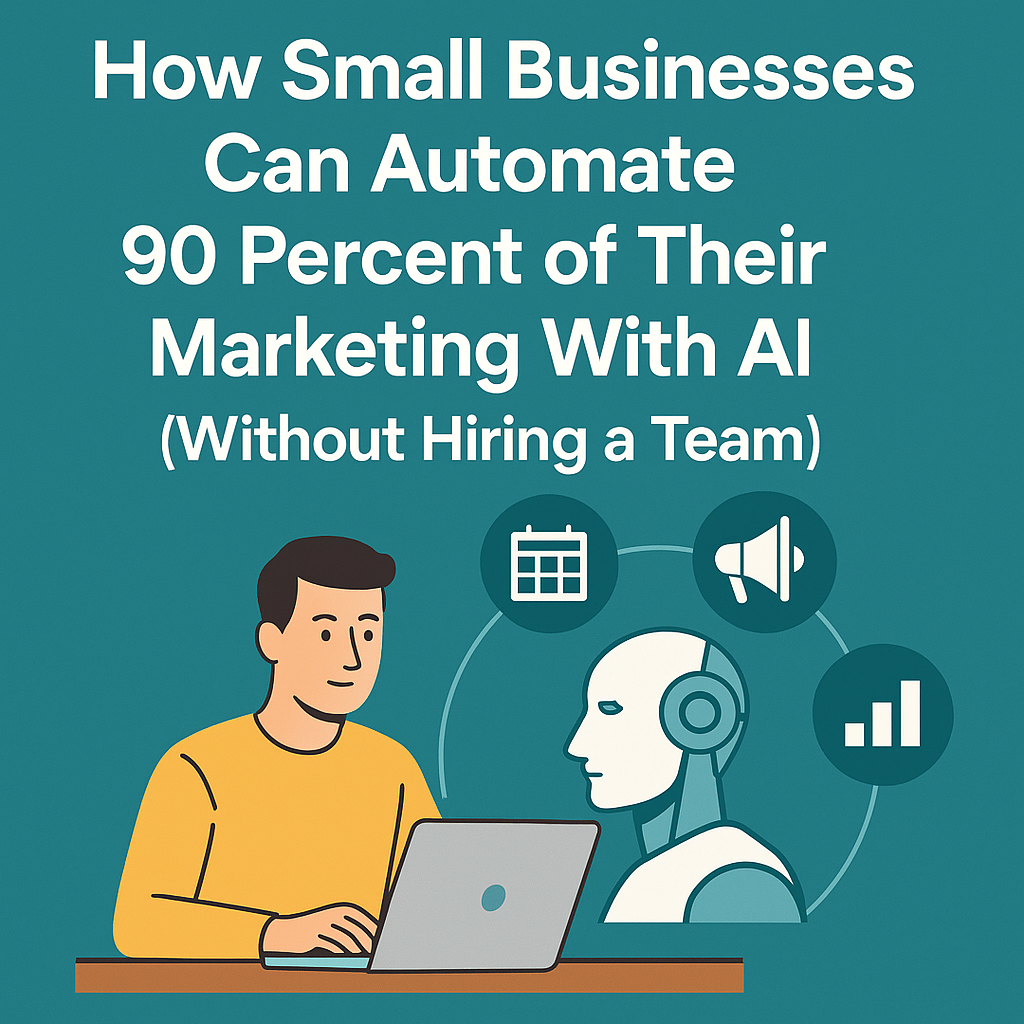
Marketing has always been a resource war. Larger companies outperform not because they have better ideas but because they have teams: strategists, writers, designers, content schedulers, analysts. Small businesses almost never compete on equal ground. Most owners are responsible for everything, including operations, sales, finances, customer service, and marketing, squeezed somewhere between.
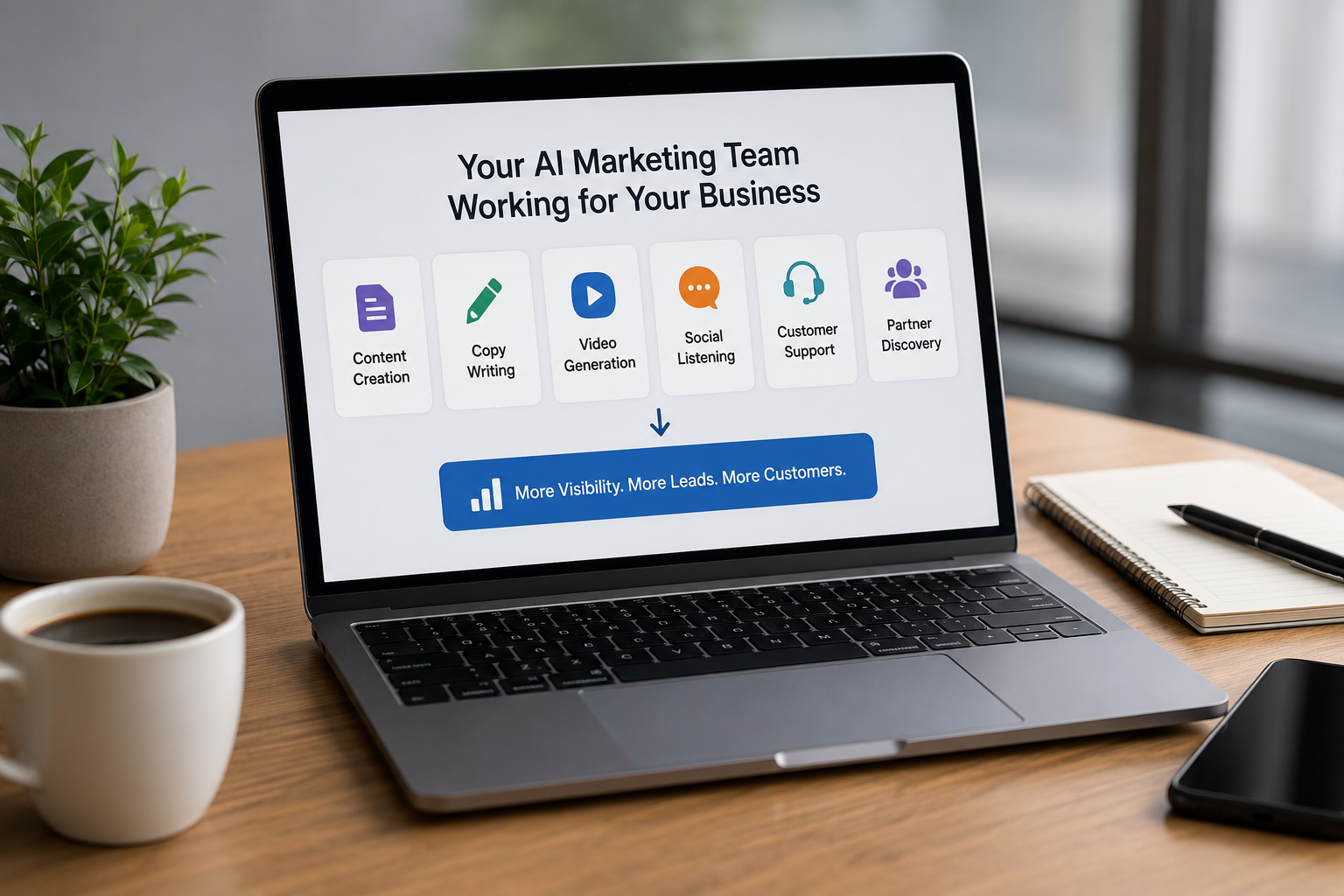
This imbalance is exactly why automated marketing is shifting from a nice-to-have to a survival requirement. Modern AI systems can now handle the majority of operational marketing tasks, including content creation, scheduling, research, brand consistency, customer communication, and follow-up sequences. This allows a business owner to operate like a company with five to seven full-time marketers.
This article explains how small businesses can automate up to 90 percent of their marketing using AI with real-world examples, operational workflows, and scenarios derived from real use across different industries.
The Foundation: What Automating Marketing Actually Means in 2025
Marketing automation today is not only scheduling posts or sending preset emails. Modern AI systems operate across three layers.
- Knowledge ingestion and learning.
The system reads websites, product descriptions, brochures, FAQs, chats, and past content to build an internal understanding of your brand. - Content level automation.
The AI generates posts, captions, email sequences, ads, and copy that stay consistent with the brand tone and specifics. - Workflow automation.
The AI handles scheduling, publishing, responding, following up, updating copy based on performance, repurposing content, and detecting trends.
When these layers operate together, you get a marketing engine that functions independently and performs hundreds of micro tasks normally requiring multiple roles.
Case Study 1: Local Music School Increasing Weekly Leads by More Than 140 Percent
A small music school in Sofia, similar to many service businesses, had a recurring problem. The owner could not consistently post content, respond to leads, or create educational posts for parents and students.
Their challenges included:
• No time to produce steady content.
• Marketing agencies cost more than their monthly profit.
• Past posts lacked consistency in tone and quality.
• No documented frequently asked questions, so parents kept asking the same things repeatedly.
How automation solved it
The school connected its website and promotional materials to an AI system. The system ingested:
• website copy
• FAQ documents
• price list
• course descriptions
• past social media posts
• photos and short videos
After a short training phase, the AI produced on-brand content automatically:
• Daily Facebook posts featuring student achievements
• Weekly educational content for parents
• Automated responses to inquiries
• Monthly campaigns for discounts and new classes
• Event reminders and holiday promotions
The owner saw a 140 percent increase in weekly inquiries within two months without increasing ad spend or hiring staff.
What was automated
• content writing
• campaign planning
• graphic suggestions
• scheduling
• FAQ replies
• newsletter sequences
The only manual task was recording short videos, which the AI used as source material.
Case Study 2: E Commerce Store Reducing Marketing Time From 25 Hours a Week to 2
A small online shop selling handmade accessories faced the classic e-commerce burden: constant product promotions, photographing new items, writing descriptions, planning campaigns, and maintaining engagement.
The owner was spending more than 20 hours every week on marketing alone.
AI transformation
After connecting product feeds and ingesting the catalog, the AI handled:
• generation of product descriptions
• weekly promotional templates
• daily Instagram and Facebook content
• automatic repurposing of customer reviews into posts
• email sequences for abandoned carts
• seasonal campaigns created on schedule
The store owner eventually spent only two hours weekly reviewing content and approving the calendar.
What was automated
• content calendar for 60 days in advance
• copywriting
• email automation
• review repurposing
• product highlight posts
• back in stock announcements
• trend-based content suggestions
This allowed the owner to scale production and double product output without worrying about marketing bandwidth.
Case Study 3: Solo Fitness Coach Operating Like a Full Marketing Team
A fitness trainer wanted to expand beyond local clients. He needed:
• daily educational content
• nutrition tips
• workout videos
• lead magnets
• email funnels
• landing pages
He had expertise but no marketing team.
Automation workflow
He uploaded:
• 40 clips
• client transformation photos
• a personal bio
• past social posts
• FAQs
• a short guide he wrote years earlier
The AI learned his voice and produced:
• daily TikTok and Instagram caption ideas
• educational posts based on his own materials
• weekly email newsletters
• automated DM replies
• 60-day content plans
• optimized landing page copy for lead generation
Within five months, he scaled from 17 clients to 64 while maintaining daily marketing output with almost no effort.
The 10 Roles AI Can Replace Inside a Small Business
A modern AI-driven marketing system performs the functions of multiple human roles.
1. Copywriter
The AI generates on-brand text after training on your materials.
Tasks automated:
• social media posts
• ad copy
• blog outlines
• landing page content
2. Content Strategist
The AI creates calendars, campaigns, and theme cycles.
3. Social Media Manager
The AI schedules posts across several networks and repurposes content.
4. Designer for simple assets
The AI generates basic visuals or prompt-based graphics.
5. Marketing Researcher
The AI identifies trends, keywords, hashtags, and competitor patterns.
6. Community Manager
The AI answers common questions using stored brand knowledge.
7. Email Marketer
The AI writes welcome sequences, promotions, reminders, and retention emails.
8. Video Script Assistant
The AI writes short scripts for TikTok, YouTube Shorts, or Reels.
9. SEO Assistant
The AI generates keyword-ready outlines and meta tags.
10. Data Analyst
The AI provides engagement insights and recommendations.
Combined, these roles replace most routine daily marketing work.
Where the 90 Percent Automation Comes From
Below is the realistic distribution of tasks.
• Social media content: 100 percent automated
• Planning: 90 percent automated
• Copywriting: 95 percent automated
• Graphics: 70 percent automated
• Email newsletters: 80 percent automated
• Landing pages: 70 percent automated
• Campaign management: 70 percent automated
• Community management: 60 percent automated
• Blog content: 60 percent automated
The business owner handles only:
• final approval
• recording authentic video
• strategy
• unique offers and updates
Framework for Automating a Small Business Marketing System
Step 1: Collect all brand materials
Website
Product descriptions
FAQ
Old posts
Brochures
Service explanations
Step 2: Train the brand brain
Feed all materials into the AI, so it learns tone, structure, logic, and value.
Step 3: Create a 60-day content calendar
The AI organizes by pillars: educational, promotional, story-based, testimonial-based, seasonal, and event-driven.
Step 4: Connect social platforms
Facebook
Instagram
LinkedIn
Twitter
Email provider
Step 5: Approve scheduled content
Quick review followed by automated publishing.
Step 6: Keep the system learning
Any new content or update is automatically ingested, so the AI stays current.
Why AI Outperforms Traditional Agencies for Small Businesses
Agencies face limitations.
• They cannot deeply learn every detail of your business.
• They reuse templates for multiple clients.
• They have onboarding time and retainer fees.
• They are slower than automated systems.
• They cannot produce daily content economically.
AI marketing offers:
• complete brand memory
• instant revisions
• unlimited content volume
• consistent voice
• very low cost per output
This results in marketing output similar to a large company but accessible to small businesses.
Real Results Small Businesses See in 60 Days
Across industries, the following patterns are consistent.
• Two to four times more weekly inquiries
• Lower cost per lead
• Higher social engagement
• Much faster content production
• Consistent presence on social platforms
• Drastic reduction in the owner's workload
Conclusion
For the first time, small businesses can compete with companies that have full marketing departments. Automating 90 percent of marketing is already a reality for service businesses, e-commerce stores, fitness professionals, educators, and niche craftsmen.
The combination of brand-trained AI, automated publishing, and continuous learning turns marketing from a weekly struggle into an autonomous engine.
Small businesses do not lose authenticity. They gain capacity.